
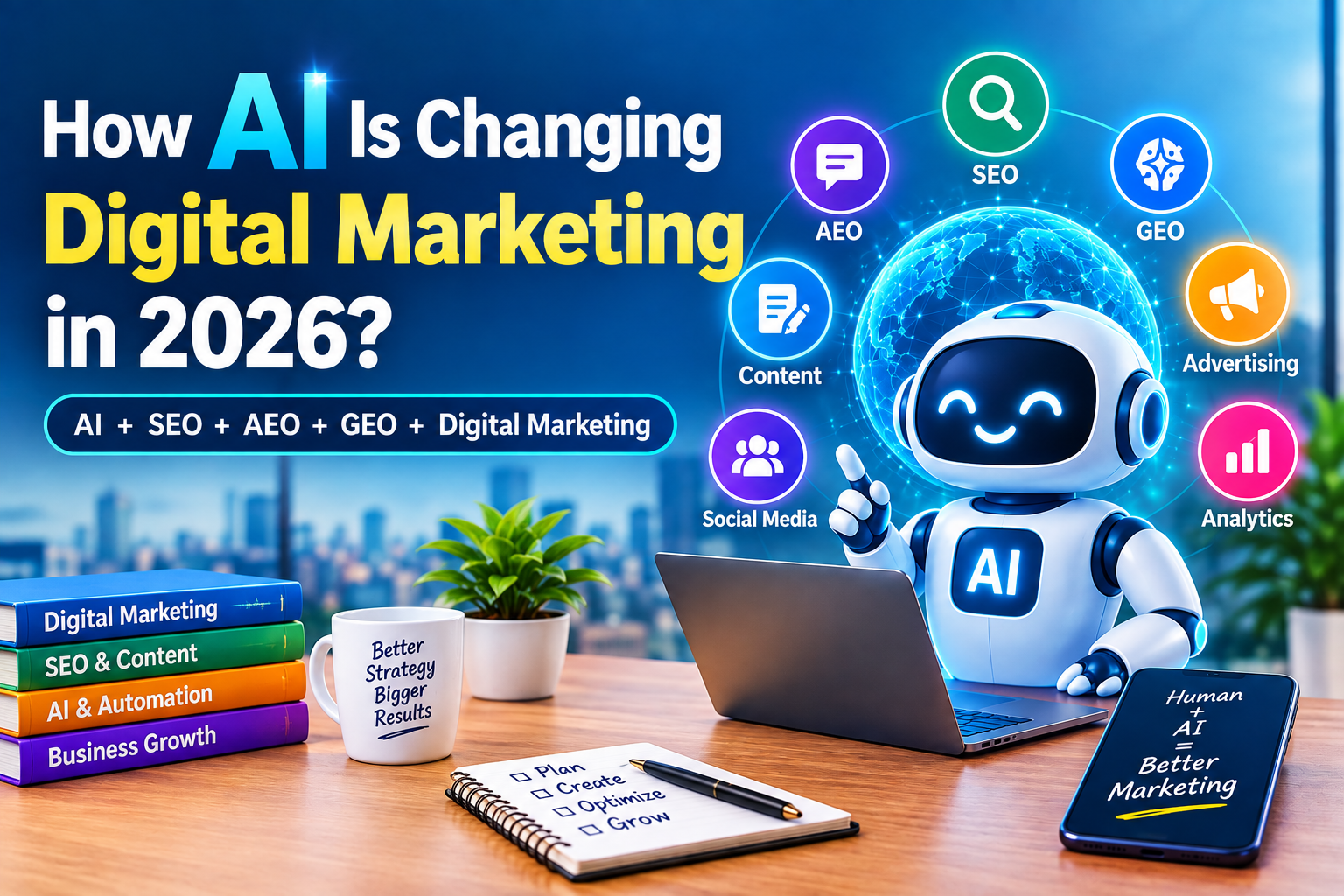
Artificial Intelligence is no longer something marketers simply talk about as “the future.” In 2026, AI has become part of the everyday digital marketing workflow.
From creating content and analyzing customer behavior to optimizing campaigns, generating ideas, automating repetitive tasks, and influencing how people discover information, AI is changing the way marketers work.
But there is an important distinction I have learned from working in digital marketing for many years:
AI is not replacing digital marketers. It is changing what it means to be a good digital marketer.
The marketers who learn how to work with AI will be able to research faster, understand customers better, experiment more frequently, and spend more time on strategy and creativity.
At the same time, businesses that simply use AI to produce large volumes of generic content may find that automation alone does not create trust, visibility, or conversions.
So, what is really changing in digital marketing in 2026?
Let’s explore it.
The Digital Marketing Landscape Is Changing
For many years, digital marketing was built around a familiar process:
Search → Website → Content → Social Media → Advertising → Conversion
That model is still important, but the customer journey is becoming much more complex.
People now use traditional search engines, AI-powered search experiences, social platforms, videos, communities, review platforms, and conversational AI tools to research products and services.
A potential customer might discover a company through Google, ask an AI tool for recommendations, watch a YouTube video, check Instagram, read reviews, visit the website, and finally contact the business.
This means marketers need to think beyond individual platforms.
The question is no longer simply:
“How do I rank my website on Google?”
The bigger question is:
“How do I make my brand visible, useful and trustworthy wherever my customers are searching for information?”
This is where AI is creating a major shift.
1. AI Is Changing How Content Is Created
Content marketing has always been one of the foundations of digital marketing.
Blogs, social media posts, email campaigns, advertisements, videos, product descriptions and landing pages all require content.
AI can now assist marketers throughout this process.
For example, AI can help with:
- Topic research
- Content ideas
- Keyword research
- Search intent analysis
- Content outlines
- First drafts
- Headlines
- Social media captions
- Email campaigns
- Ad copy
- Video scripts
- Content re purposing
- Content optimization
This dramatically reduces the time required for some marketing tasks.
But I don’t believe the goal should be to publish more content simply because AI makes content creation easier.
The goal should be to create better content.
There is a big difference.
A business can generate 100 AI-written articles, but if those articles provide little original insight, experience, evidence or value, they may not create meaningful visibility or trust.
The strongest content strategy in 2026 combines:
AI efficiency + human experience + original insights + useful information + brand perspective.
AI can help you create the framework.
Your experience gives the content its personality.
2. Search Is Moving Beyond Traditional SEO
One of the biggest changes marketers need to understand is the evolution of search.
SEO is not disappearing.
It is evolving.
For years, businesses focused heavily on ranking webpages for keywords in search engines.
Today, people increasingly expect direct answers.
They may ask questions such as:
- “Which digital marketing agency should I choose?”
- “What is the best SEO strategy for a local business?”
- “How can I promote my business online?”
- “Which digital marketing course should I take?”
- “How do I improve my website visibility?”
These questions can now be answered through AI-powered search experiences and conversational platforms.
This has created greater interest in areas such as:
SEO – Search Engine Optimization
AEO – Answer Engine Optimization
GEO – Generative Engine Optimization
The terminology may continue to evolve, but the fundamental objective remains similar:
Be visible when your audience is looking for information related to your business.
In 2026, marketers need to think about both traditional search visibility and visibility across AI-generated answers.
3. AI Is Changing Keyword Research
Traditional keyword research often focused on identifying search volume, competition and keyword variations.
AI is making keyword research much more contextual.
Instead of looking only at individual keywords, marketers can analyze:
- Search intent
- Customer questions
- Long-tail queries
- Conversational searches
- Related topics
- Pain points
- Buying signals
- Questions customers ask before purchasing
For example, instead of targeting only:
“Digital marketing consultant”
a business may need content addressing questions such as:
- What does a digital marketing consultant do?
- How much does digital marketing consulting cost?
- How can a consultant help a small business?
- Should I hire an agency or consultant?
- How can I improve my online presence?
- How do I generate leads through digital marketing?
The focus is moving from keywords to conversations and customer intent.
4. Personalization Is Becoming More Powerful
One of the most exciting applications of AI in digital marketing is personalization.
Customers don’t all behave in the same way.
A first-time website visitor may need educational information.
A returning visitor may be comparing services.
A customer who has already purchased may be interested in another product or service.
AI can help businesses analyze these different customer signals and create more relevant experiences.
This can influence:
- Website recommendations
- Email campaigns
- Product recommendations
- Advertising
- Customer segmentation
- Offers
- Content recommendations
- Lead nurturing
The important word here is relevance.
Customers don’t necessarily want more marketing.
They want marketing that makes sense to them.
5. AI Is Transforming Digital Advertising
Paid advertising is another area where AI is having a significant impact.
Platforms increasingly use machine learning and automation to help advertisers with:
- Audience targeting
- Campaign optimization
- Budget allocation
- Creative testing
- Bidding
- Conversion optimization
- Performance analysis
Marketers can also use AI to generate multiple versions of ad copy, headlines and creative concepts for testing.
But automation does not eliminate the need for strategy.
A poorly defined campaign objective cannot be fixed simply by using AI.
If the offer is weak, the landing page is confusing, or the target audience is wrong, automation will not magically solve the problem.AI can optimize a campaign. It cannot replace a sound marketing strategy.
6. Social Media Marketing Is Becoming More Intelligent
Social media marketers traditionally spend a significant amount of time creating content calendars, writing captions, designing creatives and monitoring performance.
AI can reduce the repetitive workload.
A marketer can use AI to brainstorm:
- Content themes
- Post ideas
- Reel concepts
- Video scripts
- Captions
- Hashtags
- Content calendars
- Audience questions
- Campaign concepts
AI can also help analyze engagement patterns and identify content themes that deserve further attention.
However, social media is still fundamentally about people.
A perfectly optimized caption cannot replace authenticity.
Customers respond to:
Stories. Experiences. Opinions. Personality. Relevance. That is why human creativity remains extremely important.
7. Video Marketing Is Getting Easier
Video has become one of the most powerful formats for digital communication.
AI is making video production more accessible to businesses and individual creators.
AI-assisted tools can support:
- Script writing
- Video planning
- Voice generation
- Subtitles
- Editing
- Translation
- Content re purposing
- Short-form video creation
This means businesses that previously considered video production too expensive or complicated can experiment more easily.
For marketers, this creates another opportunity:
One long-form piece of content can become a blog article, LinkedIn post, Instagram Reel, YouTube Short, email newsletter and several social media posts. This is where AI can become a powerful content re purposing assistant.
8. AI Is Improving Marketing Analytics
Digital marketers have always had access to large amounts of data.
The challenge has been understanding what the data actually means.
AI can help marketers identify patterns across large datasets and make analysis easier.
Instead of simply looking at:
Traffic → Leads → Conversions
marketers can ask deeper questions:
- Which channels are generating qualified leads?
- Which content contributes to conversions?
- Where are customers dropping out?
- Which campaigns are producing poor-quality leads?
- Which audience segments are more engaged?
- What changes occurred after a campaign modification?
The role of the marketer is gradually moving from reporting numbers to interpreting business signals. That is an important shift.
9. AI Is Changing Customer Service and Lead Generation
AI-powered chat bots and conversational systems are becoming increasingly useful for businesses.
They can help answer common questions, qualify leads, provide basic information and guide visitors toward relevant pages or services.
For example, a website visitor might ask:
“Do you provide digital marketing services for small businesses?”
An AI assistant can respond immediately, explain relevant services and guide the visitor toward an inquiry form or consultation.
This can help businesses provide support beyond traditional working hours.
However, not every customer interaction should be automated.
Some conversations require human understanding, negotiation, expertise or empathy.
The best approach is often:AI for speed + humans for important decisions and relationships.
10. AI Is Changing How Brands Build Authority
This is an area that I believe businesses need to take seriously.
When AI systems provide answers, they need information from somewhere.
Brands that consistently publish useful, credible and well-structured information have an opportunity to strengthen their digital presence.
That means businesses should not think only about publishing promotional content.
They should demonstrate:
- Experience
- Expertise
- Original insights
- Case studies
- Customer experiences
- Industry knowledge
- Author credibility
- Useful answers
- Real examples
In other words, brand authority is becoming increasingly important.
A company website should not simply say:
“We are the best.”
It should demonstrate why customers should trust the company.
11. AI Does Not Mean “Publish Everything Automatically”
This is probably one of the biggest misconceptions about AI marketing.
Because AI can create content quickly, some businesses may be tempted to automate everything.
That can create problems.
Imagine two websites.
Website A publishes hundreds of generic AI-generated articles.
Website B publishes fewer articles but includes:
- Original research
- Expert opinions
- Real customer questions
- Case studies
- Industry examples
- First-hand experiences
- Practical recommendations
Which website creates more meaningful value for the audience?
Quantity alone is not a sustainable content strategy.
AI should increase productivity, not decrease quality.
12. Human Creativity Is Becoming More Valuable
Ironically, the more AI-generated content we see, the more valuable genuine human perspectives can become.
AI can generate a reasonable article about digital marketing.
But AI does not have my 19+ years of personal experience working with businesses, websites, marketing campaigns, students and entrepreneurs.
That experience influences how I approach a marketing problem.
For example, two businesses may have similar websites and budgets but completely different challenges.
One may need better positioning.
Another may need lead generation.
Another may have a traffic problem.
Another may have plenty of traffic but poor conversions.
AI can help analyze these situations.
But strategy requires context. And context comes from understanding the business, the customer and the market.
AI + Human Expertise: The New Digital Marketing Model
I believe the future of digital marketing is not:
Human vs AI
It is:
Human + AI
A modern marketer can use AI for:
Research
Finding ideas, questions, trends and information faster.
Analysis
Understanding customer behavior, campaigns and data.
Creation
Producing initial drafts, concepts and variations.
Automation
Reducing repetitive marketing tasks.
Optimization
Testing and improving campaigns and content.
Strategy
The human marketer decides what matters, why it matters and how it connects to business objectives. This combination can make marketing significantly more efficient.
What Should Digital Marketers Learn in 2026?
If you are a digital marketing professional or someone starting your career, I would not recommend learning only AI tools.
Tools will continue to change.
Instead, develop a strong foundation in:
- Digital marketing strategy
- SEO
- AEO
- GEO
- Content marketing
- Social media marketing
- Paid advertising
- Analytics
- Conversion optimization
- Branding
- Customer psychology
- AI prompting and workflows
- AI-assisted content creation
- Data interpretation
- Marketing automation
Most importantly:
Learn how to solve business problems.
Knowing 50 AI tools is less valuable than knowing how to use the right tool to solve the right problem.
What Should Businesses Do Now?
Businesses don’t necessarily need to adopt every new AI tool.
Instead, start with your biggest marketing challenges.
Ask:
Where are we losing time?
Where are we losing leads?
What marketing activities are repetitive?
What customer questions do we receive repeatedly?
What content do our customers actually need?
Where are our competitors getting visibility?
Are customers finding us through traditional search and emerging AI search experiences?
Then identify where AI can genuinely improve the process.
Start small.
Test.
Measure.
Improve.
Scale what works.
The Future of Digital Marketing Is Not Fully Automated
I don’t believe the future of digital marketing will be completely automated.
Marketing is ultimately about people.
People have emotions.
People have preferences.
People build trust.
People make decisions.
Technology can help us understand and communicate with people more efficiently, but relationships remain human.
The most successful marketers in the coming years will likely be those who combine three things:
Technology + Strategy + Human Understanding
AI can provide speed.
Data can provide insights. But human creativity, experience and judgment turn those inputs into meaningful marketing.
Final Thoughts
AI is changing almost every stage of digital marketing—from research and content creation to advertising, analytics, personalization, customer service and search.
But I see AI less as a replacement for marketers and more as a powerful new layer of capability.
The real opportunity is not simply to use AI.
It is to use AI intelligently.
As we move deeper into 2026, businesses and marketers should focus less on asking:
“Which AI tool should I use?”
and more on asking:
“How can AI help me create better experiences, solve customer problems and achieve better business results?”
That is where the real value of AI in digital marketing lies.
And perhaps the biggest lesson is this:
AI can generate content.
AI can analyze data.
AI can automate tasks.
But human experience, creativity and strategic thinking still make marketing meaningful. The future belongs not to marketers who compete with AI, but to marketers who learn how to work effectively with it.
