
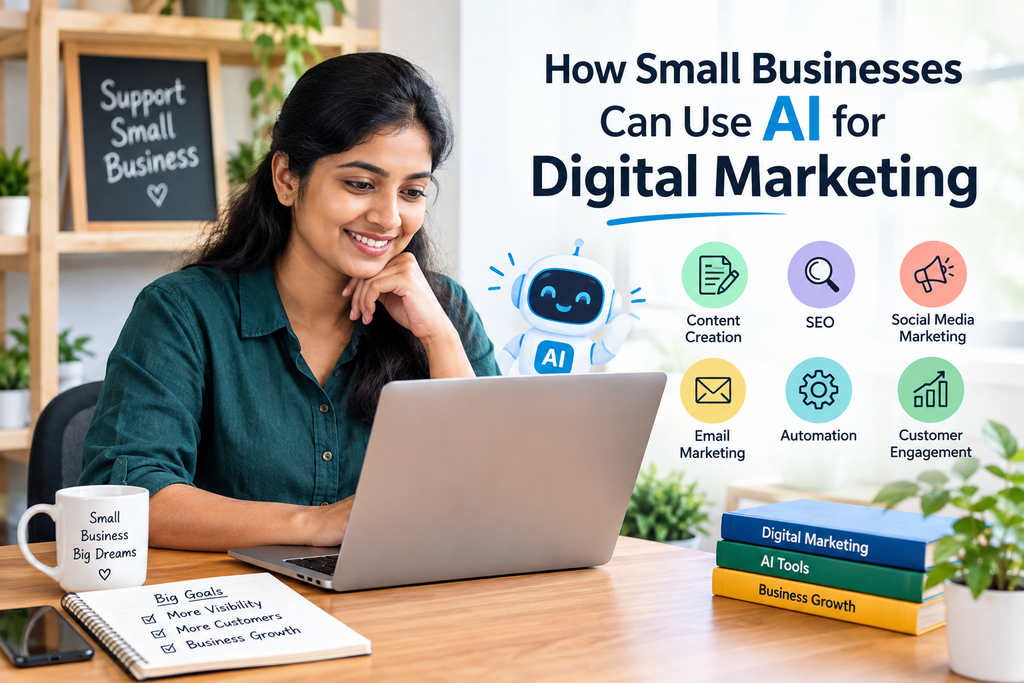
Artificial intelligence (AI) is no longer something that only large companies with big technology budgets can use. Today, even a small business can use AI to save time, create better content, understand customers, and improve digital marketing.
For a small business owner, the biggest challenge is often not knowing what to do, but finding enough time to do everything.
You need to manage customers, answer enquiries, handle operations, create social media posts, update your website, run advertisements, and still find time to grow the business.
This is where AI can become a practical marketing assistant.
AI will not replace your understanding of your customers or your personal connection with them. Instead, it can handle many repetitive tasks and help you work faster.
Let’s look at some practical ways small businesses can use AI for digital marketing.
1. Use AI to Create Content Ideas
Coming up with fresh content ideas every week can be difficult.
You may know your business very well, but that doesn’t mean you always know what to post on Instagram, Facebook, LinkedIn, or your blog.
AI can help you brainstorm content ideas based on your:
- Business type
- Target audience
- Products or services
- Customer problems
- Industry trends
- Frequently asked questions
For example, imagine you run a local digital marketing agency.
Instead of asking AI:
“Give me some social media ideas.”
You could give it more context:
“I run a digital marketing agency for small businesses in Tamil Nadu. Suggest 20 Instagram post ideas that address common digital marketing problems faced by local business owners.”
The more useful information you provide, the more relevant the ideas are likely to be.
The important thing is not to publish every AI-generated idea without thinking. Use AI for brainstorming, and then add your own experience and perspective.
That human touch is what makes content valuable.
2. Write First Drafts Faster
Writing a blog post, email, social media caption, or advertisement from a blank page can take a lot of time.
AI can help you create a first draft.
For example, you can ask AI to create:
- A blog post outline
- A Facebook caption
- An Instagram caption
- An email newsletter
- Product descriptions
- Website content
- Frequently asked questions
- Video scripts
- Advertisement copy
This doesn’t mean you should simply copy and paste whatever AI produces.
Think of AI as your first-draft assistant.
You can then add your personal experiences, examples, opinions, customer stories, and local knowledge.
The result will usually be much more authentic than generic AI-generated content
4. Use AI for SEO Keyword Research
Search engine optimization (SEO) can feel complicated, especially if you are just starting.
AI can help you identify topics and keywords your potential customers may search for.
For example, if you own a bakery in your city, potential search terms could include:
- Best bakery near me
- Birthday cake delivery
- Custom wedding cakes
- Eggless cakes
- Cake delivery in [city name]
- Best cakes for birthdays
AI can help you brainstorm related topics and organize them into content ideas.
However, AI-generated keyword suggestions should not be treated as guaranteed search-volume data.
For serious SEO research, combine AI brainstorming with actual SEO and search-engine data.
The goal is to understand what your customers are looking for and create useful content around those needs.
Social media requires consistency.
Many small businesses create a few posts when they have time and then disappear for several weeks. AI can help you maintain a more consistent content schedule.
For example, you can create a monthly content plan covering:
- Educational posts
- Customer questions
- Product demonstrations
- Behind-the-scenes content
- Testimonials
- Offers and promotions
- Industry tips
- Frequently asked questions
You can also ask AI to turn one piece of content into multiple formats.
For example, a blog post about “5 Ways to Improve Local SEO” could become:
- A LinkedIn post
- An Instagram carousel
- A Facebook post
- A short video script
- An email newsletter
- Several short social media posts
This is one of the most useful ways small businesses can use AI: create once and repurpose intelligently.
5. Create Better Customer Personas
Do you know exactly who your ideal customer is?
Many small businesses have a general idea, but they haven’t clearly documented it.
AI can help you organize what you already know about your customers.
For example, you could provide information about your typical customers and ask AI to help identify:
- Their common problems
- Their goals
- Their buying concerns
- Questions they may ask
- Reasons they may hesitate to purchase
- Content topics that could help them
This can make your marketing messages more focused.
Instead of saying:
“We provide high-quality accounting services.”
You may discover that your customers are particularly concerned about saving time, avoiding mistakes, or understanding their tax obligations.
That insight can help you create more relevant marketing messages.
6. Personalize Email Marketing
Email marketing can become much more effective when messages are relevant to the recipient.
AI can help you create different versions of emails for different customer groups.
For example, an online store could have different messages for:
- First-time customers
- Repeat customers
- Customers who haven’t purchased recently
- Customers interested in a particular product category
- Customers who abandoned their shopping cart
AI can help draft these messages and suggest subject lines.
But personalization should be genuine.
Don’t use personal information simply because you can. Use customer data responsibly and respect privacy requirements.
7. Make Better Advertisements
Small businesses often have limited advertising budgets.
That makes it important to test different messages rather than spending money on a single advertisement and hoping it works.
AI can help you create multiple versions of:
- Headlines
- Ad descriptions
- Calls to action
- Social media advertisements
- Promotional messages
- Landing-page copy
For example, instead of creating one headline, you could ask AI for ten different approaches focused on different customer benefits.
You can then test the variations and use actual campaign data to determine which messages perform better.
AI can help you create the options.
Your advertising platform and real customer behaviour provide the evidence.
8. Improve Your Website Content
Your website is often the first place a potential customer goes before contacting your business.
AI can help you review your website content and identify areas that may be unclear.
For example, you can ask AI to help evaluate whether your:
- Homepage clearly explains what you offer
- Service pages answer customer questions
- Calls to action are easy to understand
- FAQs address common concerns
- Product descriptions are clear
- Content is written for your target audience
You can also use AI to create an initial FAQ section based on common customer questions.
But always review the information carefully, especially when your website provides professional, financial, legal, medical, or technical information.
9. Use AI to Understand Customer Reviews
Customer reviews contain valuable marketing information.
Instead of reading hundreds of reviews individually, AI can help you identify recurring themes.
For example, you may discover that customers frequently mention:
- Fast delivery
- Friendly service
- Product quality
- Difficult ordering process
- Slow response times
- Pricing concerns
Positive feedback can give you ideas for marketing messages.
Negative feedback can highlight areas where your business could improve.
In this way, AI isn’t just a content tool. It can also help you listen to your customers.
10. Create Video Content More Easily
Video marketing can be intimidating for small businesses.
You don’t necessarily need a professional studio or a large production team.
AI can help with parts of the video creation process, such as:
- Video ideas
- Scripts
- Hooks
- Captions
- Titles
- Content outlines
- Repurposing long videos into short clips
For example, a business owner could record a five-minute video explaining a common customer problem.
AI could then help turn that topic into several short-video ideas.
The actual experience and knowledge still come from the business owner.
AI simply helps package that knowledge into different formats.
11. Automate Repetitive Marketing Tasks
One of the biggest benefits of AI is automation.
Depending on the tools you use, you can automate parts of your marketing workflow, such as:
- Scheduling social media content
- Email sequences
- Lead follow-ups
- Customer support responses
- Reporting
- Data organization
- Content repurposing
Automation can give small-business owners something extremely valuable:
time.
Instead of spending hours performing repetitive tasks, you can spend more time talking to customers, improving your products, and growing the business.
12. Don’t Forget the Human Side of Marketing
This is probably the most important point.
AI can generate text.
It can analyze information.
It can suggest ideas.
It can automate repetitive tasks.
But it doesn’t know your customers the way you do.
Your customers don’t necessarily want perfectly polished content. They want useful information from a business they can trust.
That’s why your own experiences, stories, opinions, photographs, customer conversations, and expertise still matter.
A good approach is:
AI + Human Experience = Better Marketing
Use AI for speed and efficiency.
Use your own knowledge for authenticity and trust.
A Simple AI Marketing Workflow for Small Businesses
If you’re completely new to AI, don’t try to automate your entire marketing operation on day one.
Start small.
A simple workflow could look like this:
Step 1: Choose one marketing problem
For example:
“I don’t have enough ideas for social media.”
Step 2: Use AI to brainstorm
Ask AI for 20–30 relevant content ideas based on your business and target audience.
Step 3: Select the best ideas
Don’t publish everything. Choose the topics that are genuinely useful to your customers.
Step 4: Add your experience
Include real examples, customer questions, stories, images, and your own perspective.
Step 5: Create multiple formats
Turn one useful idea into a blog post, social media post, email, or video.
Step 6: Measure the results
Look at meaningful metrics such as:
- Website traffic
- Enquiries
- Leads
- Sales
- Engagement
- Email responses
- Conversion rates
Step 7: Improve
Use the results to decide what to create next.
This approach is much more practical than simply generating large amounts of AI content.
Common Mistakes Small Businesses Should Avoid
AI can save time, but it can also create new problems when used carelessly.
Publishing AI content without editing
AI-generated content can sometimes sound generic or contain inaccurate information.
Always review it before publishing.
Trying to automate everything
Not every customer interaction should be automated.
Important conversations may require a real person.
Ignoring your brand voice
If every business uses similar AI prompts, their content can start sounding the same.
Give AI examples of your existing writing style and then edit the output to make it sound like your business.
Creating content without a strategy
Producing 100 social media posts won’t necessarily grow your business.
Start with your business goals and customer needs.
Sharing confidential information
Don’t blindly paste sensitive customer, financial, business, or personal information into AI tools.
Understand how the tool handles data and follow applicable privacy requirements.
The Future of AI for Small Business Marketing
AI is changing quickly.
The tools available today will continue to evolve, become easier to use, and become more integrated into everyday marketing platforms.
For small businesses, the opportunity isn’t necessarily to use the most advanced AI technology.
It’s to use the right technology to solve real problems.
If AI helps you create content faster, respond to customers more efficiently, understand your audience better, or spend less time on repetitive tasks, it can provide real value.
But technology should remain a tool—not the entire marketing strategy.
Your customers, your expertise, and your understanding of your market should remain at the centre.
Final Thoughts
You don’t need a large marketing team to start using AI.
Start with one simple task.
Use AI to brainstorm content. Then try it for social media. Later, experiment with email marketing, SEO, customer feedback, or automation.
The key is to experiment, measure the results, and keep improving.
The businesses that benefit most from AI won’t necessarily be the ones that generate the most content.
They will be the ones that use AI thoughtfully to save time, understand customers, and deliver more value.
AI can help you work faster.
But your human experience is what makes your marketing worth listening to.