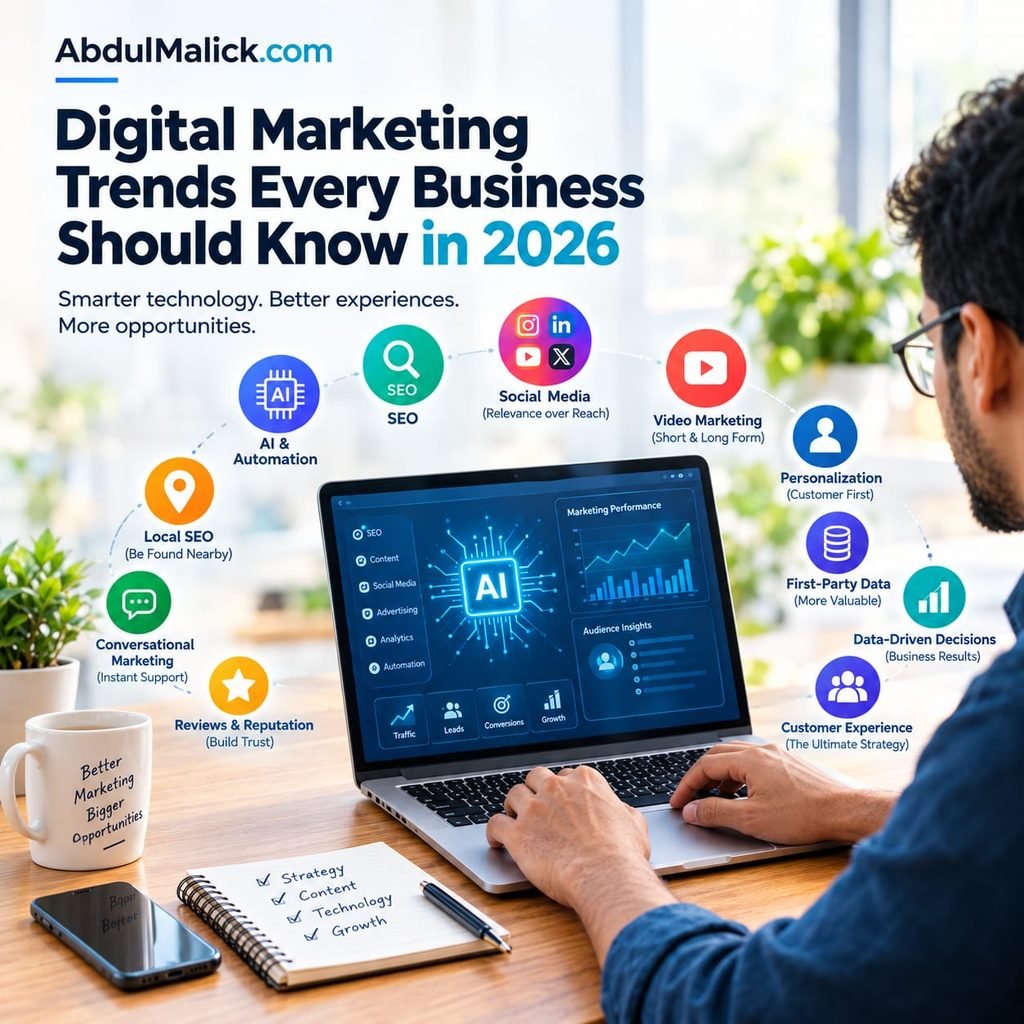
Digital marketing has never been a static industry.
The way people discover businesses, compare products, consume content and make purchasing decisions keeps changing. What worked a few years ago may still work today, but the way we use those strategies has changed significantly.
In 2026, one of the biggest forces behind this change is Artificial Intelligence.
But AI is only one part of the story.
Search is changing. Customer expectations are changing. Content is changing. Social media is becoming more competitive. First-party data is becoming more important. And businesses are increasingly expected to provide useful information rather than simply promote their products or services.
After spending years working in digital marketing, I have learned that businesses don’t need to chase every new trend.
They need to understand which changes will actually affect their customers and their business.
So, let’s look at the digital marketing trends that businesses should pay attention to in 2026.
1. AI Is Becoming Part of Everyday Marketing
Artificial Intelligence is no longer limited to experimental projects.
Businesses are using AI across different stages of marketing, including:
- Content research
- Content creation
- Customer analysis
- SEO
- Advertising
- Email marketing
- Social media
- Data analysis
- Customer support
- Marketing automation
For a small business, this can be particularly useful.
A business owner who previously spent several hours researching content ideas can use AI to speed up the research process.
A marketing team can generate multiple campaign concepts and then spend more time evaluating and improving them.
A customer support team can automate repetitive questions while allowing employees to focus on more complex conversations.
But there is an important point here.
Using AI does not automatically mean doing better marketing.
The quality of the strategy still matters.
2. Search Is Moving Beyond Traditional Google Results
For many years, SEO strategy was largely focused on ranking webpages in search engine results.
That remains important.
But search behaviour is expanding.
People are increasingly asking conversational questions through AI-powered search experiences and other digital platforms.
Instead of typing:
“digital marketing agency Madurai”
a customer might ask:
“What should a small business in Madurai consider before choosing a digital marketing agency?”
These are two very different types of searches.
The second search reflects a conversation and an information need.
This is why marketers need to think beyond traditional SEO and understand areas such as:
SEO – Search Engine Optimization
AEO – Answer Engine Optimization
GEO – Generative Engine Optimization
The terminology will continue to evolve, but the underlying principle is simple:
Create useful information that helps your audience—and make your brand discoverable wherever they search.
3. Helpful Content Is Becoming More Important Than Content Volume
AI has made content creation dramatically faster.
That creates an interesting challenge.
If everyone can produce content quickly, simply producing more content is no longer a competitive advantage.
Businesses need to ask:
“Why should someone read our content?”
The answer should be clear.
Your content should provide something valuable, such as:
- Real experience
- Original research
- Practical examples
- Customer questions
- Industry knowledge
For example, instead of publishing another generic article titled:
“10 Benefits of Digital Marketing”
a business could publish:
“What We Learned After Running Digital Marketing Campaigns for Small Businesses”
The second approach brings experience into the conversation. That human element becomes increasingly valuable in an AI-driven content environment.
4. First-Hand Experience Is Becoming a Marketing Asset
This is closely connected to the previous trend.
AI can summarize information that already exists.
But businesses have something AI cannot simply manufacture:
their own experience.
Think about the knowledge your business has accumulated.
You may have:
- Customer success stories
- Project experiences
- Common customer questions
- Industry observations
- Mistakes you’ve made
- Solutions you’ve developed
- Before-and-after results
- Lessons from difficult projects
These experiences can become powerful marketing content.
A business shouldn’t be afraid to share what it has learned.
In fact, those experiences can differentiate your brand from thousands of websites publishing similar generic information.
Your experience is content.
5. Short-Form Video Continues to Matter
People’s attention is increasingly fragmented.
Short-form video has become a major part of how audiences discover brands, products, people and ideas.
Platforms such as Instagram, YouTube and other social platforms provide businesses with opportunities to communicate through:
- Reels
- Shorts
- Tutorials
- Product demonstrations
- Customer stories
- Behind-the-scenes content
- Educational videos
- Expert tips
But businesses should avoid creating videos simply because everyone else is doing it.
Start with the customer.
Ask:
What does my customer want to know?
Then create the video around that question.
A 30-second video answering a genuine customer problem can be more useful than a highly produced promotional video that says very little.
6. Video Content Is Becoming a Search Strategy
Video isn’t just about social media anymore.
People also use video platforms to search for information.
Someone who wants to learn how to use a product may search for a tutorial.
Someone planning a purchase may watch product reviews.
Someone learning a skill may search for an expert explaining the topic.
This creates an opportunity for businesses to build a library of useful videos.
For example:
A manufacturer can explain how its product works.
A consultant can answer common customer questions.
A restaurant can showcase its kitchen and signature dishes.
A training institute can publish educational lessons.
A professional service business can explain complicated topics in simple language.
Video can therefore support both brand awareness and information discovery.
7. Personal Branding Is Becoming More Important
People don’t always want to interact with a faceless brand.
They want to know the people behind the business.
This is one reason personal branding has become increasingly important.
Customers may want to know:
- Who is the founder?
- Who are the experts?
- What does the company believe in?
- What experience does the team have?
- What problems have they solved?
- Can I trust them?
For consultants, trainers, founders and professionals, personal branding can become a powerful part of digital marketing.
Your website, LinkedIn profile, videos, articles and social media presence can work together to communicate your expertise.
In an AI-heavy digital environment, a genuine human voice can become a competitive advantage.
8. Social Media Is Moving From Reach to Relevance
For years, businesses often focused on follower counts and impressions.
Those numbers still have their place.
But they don’t necessarily tell the whole story.
A business can have thousands of followers and still struggle to generate enquiries.
The more important questions are:
- Are the right people seeing our content?
- Are they engaging with it?
- Are they visiting our website?
- Are they asking questions?
- Are they becoming leads?
- Are they becoming customers?
- Are existing customers staying connected?
This means businesses need to focus on relevance and relationships, not just reach.
A smaller but highly relevant audience can be valuable for a business.
9. Marketing Is Becoming More Conversational
Customers increasingly expect businesses to answer their questions quickly.
They don’t want to search through ten different pages to find a simple answer.
This is contributing to the growth of conversational experiences.
Businesses can use AI-powered assistants, chatbots and messaging platforms to help customers with:
- Product questions
- Service information
- Pricing-related queries
- Appointment enquiries
- Product selection
- Basic troubleshooting
- Lead qualification
But automation needs to be handled carefully.
If every customer interaction feels robotic, it can damage the experience.
The goal should be:
Automation where it helps. Humans where they matter.
10. Personalization Is Becoming a Customer Expectation
Customers don’t all have the same needs.
Consider an online store.
A new visitor may need product education.
A returning customer may already know what they want.
A previous customer may be interested in complementary products.
Treating all three people exactly the same isn’t necessarily the best approach.
AI and marketing automation can help businesses create more relevant experiences based on customer behaviour.
Personalization can be applied to:
- Website content
- Product recommendations
- Advertising
- Offers
- Customer journeys
- Lead nurturing
But personalization should provide genuine value.
Customers should feel understood—not monitored.
11. First-Party Data Is Becoming More Valuable
Businesses have traditionally depended on different advertising and analytics platforms for customer information.
But businesses increasingly need to understand and responsibly use the data they collect directly from their own customers.
This can include information from:
- Website enquiries
- Customer registrations
- Email subscribers
- Purchases
- CRM systems
- Customer feedback
- Website interactions
This is often referred to as first-party data.
The advantage is that businesses can build a better understanding of their own customers instead of depending entirely on external platforms.
The key requirement is responsible data collection and appropriate privacy practices.
12. Local Search Still Matters
For businesses that serve a particular city or region, local digital visibility remains extremely important.
Imagine someone searching for:
“Best interior designer near me”
or:
“Digital marketing consultant in Madurai”
or:
“Best restaurant near me.”
These customers aren’t looking for a business somewhere in the world.
They are looking for something relevant to their location.
Businesses should therefore pay attention to:
- Google Business Profile
- Local SEO
- Reviews
- Location-specific content
- Consistent business information
- Local customer experiences
A business that operates locally should make sure its digital presence clearly communicates where it operates and whom it serves.
13. Reviews and Reputation Are Becoming More Important
Before purchasing, customers often want reassurance.
They may look at:
- Google reviews
- Social media comments
- Testimonials
- Customer experiences
- Case studies
- Online discussions
A company’s reputation is no longer something that exists separately from digital marketing.
Reputation is part of digital marketing.
Businesses should therefore have a process for:
- Asking satisfied customers for genuine reviews
- Responding professionally to feedback
- Learning from complaints
- Showcasing authentic customer experiences
- Monitoring their online reputation
Businesses cannot control every conversation about them. But they can control how they respond.
14. Marketing and Sales Need to Work Together
One of the biggest problems I see in businesses is the separation between Marketing and Sales.
Marketing generates traffic.
Sales handles enquiries.
But if these two teams don’t communicate, opportunities can be lost.
For example, Marketing may believe that a campaign is successful because it generated 1,000 leads.
Sales may discover that only a small percentage of those leads were relevant.
That means the real question isn’t:
“How many leads did we generate?”
It is:
“How many useful business opportunities did our marketing create?”
AI and better analytics can help businesses connect Marketing data with actual business outcomes.
15. Marketing Automation Is Moving Beyond Simple Scheduling
Marketing automation used to mean scheduling emails or social media posts.
Today, automation can be much more sophisticated.
Businesses can create workflows around:
- Lead nurturing
- Email sequences
- Customer onboarding
- Follow-ups
- Content distribution
- Customer segmentation
- CRM updates
- Reporting
- Re-engagement
AI can make these workflows more intelligent by helping businesses understand customer behaviour and determine what communication may be relevant.
The objective should not be to automate everything.
It should be to remove repetitive work so people can focus on higher-value activities.
16. Data-Driven Decision Making Is Becoming Essential
Marketing decisions based purely on assumptions can be expensive.
In 2026, businesses have access to more data than ever.
The challenge is turning that data into decisions.
Instead of asking:
«“Which campaign got the most clicks?”»
businesses should ask:
«“Which campaign contributed to meaningful business results?”»
Instead of:
«“Which post got the most likes?”»
ask:
«“Which content attracted the right audience?”»
Instead of:
«“How much website traffic did we receive?”»
ask:
«“Did that traffic generate qualified enquiries or sales?”»
This shift—from vanity metrics to business metrics—is critical.
17. Customer Experience Is Becoming a Marketing Strategy
Marketing doesn’t end when someone becomes a customer.
The customer’s experience after the purchase can influence:
- Reviews
- Referrals
- Repeat purchases
- Brand reputation
- Social media conversations
This means Marketing, Sales and Customer Service cannot operate completely independently.
The customer sees one brand.
They don’t care which internal department is responsible for a particular problem.
Every interaction contributes to their perception of the company.
Customer experience is marketing.
18. Businesses Need an AI Policy for Content and Data
As AI becomes part of everyday marketing, businesses should also think about responsible usage.
For example:
- Which AI tools can employees use?
- What company information can be entered into AI systems?
- How should AI-generated content be reviewed?
- Who is responsible for fact-checking?
- How should customer data be protected?
- When should human approval be required?
These questions become increasingly important as AI adoption grows.
AI should be treated as a business capability—not simply as another software subscription.
What Should Businesses Actually Do in 2026?
After looking at all these trends, there is one thing I would caution businesses against:
Don’t try to implement everything at once.
You don’t need 20 AI tools.
You don’t need to be present on every social media platform.
You don’t need to publish content every day.
Instead, start with your business objectives.
Ask:
1. What are we trying to achieve?
More leads?
More sales?
Better brand awareness?
Customer retention?
Local visibility?
2. Who are our customers?
Understand their problems, questions, motivations and buying behaviour.
3. Where do they search?
Google?
AI search?
YouTube?
Instagram?
LinkedIn?
Local platforms?
4. What content do they need?
Educational content?
Demonstrations?
Reviews?
Comparisons?
Case studies?
5. Where can AI help?
Research?
Content?
Analytics?
Automation?
Customer support?
6. How will we measure success?
Traffic?
Qualified leads?
Conversions?
Revenue?
Customer retention?
The answers to these questions should determine your digital marketing strategy—not the latest trend on social media.
The Biggest Digital Marketing Lesson for 2026
If I had to summarize the direction of digital marketing in one sentence, it would be this:
Technology is becoming more intelligent, but marketing still needs to remain human.
AI can help us work faster.
Automation can help us save time.
Analytics can help us make better decisions.
Search technology can help customers find information faster.
But businesses still need:
Trust.
Experience.
Creativity.
Strategy.
Human connection.
These fundamentals are not going away.
In fact, as AI-generated content becomes more common, genuine expertise and authentic experiences may become even more valuable.
Final Thoughts
Digital Marketing in 2026 is not about following every new technology.
It is about understanding how technology is changing customer behaviour and adapting your business accordingly.
AI, AI-powered search, short-form video, personalization, first-party data, automation, personal branding, local SEO and customer experience are all important developments.
But businesses should not adopt a trend simply because everyone is talking about it.
Start with the customer.
Understand their problems.
Understand how they search.
Create useful content.
Build trust.
Use technology where it genuinely improves the experience.
And measure what actually contributes to your business goals.
The businesses that approach digital marketing this way will be better prepared for a digital environment that is becoming more intelligent, more conversational and more customer-driven.
The future of digital marketing isn’t simply about more technology.
It is about using technology more intelligently.
AI may change the tools we use.
But understanding people will continue to be the foundation of good marketing.