Imagine you want to find the best digital marketing course, a reliable service provider, or an answer to a question. A few years ago, you might have opened Google, typed a keyword, and visited several websites. Today, you might ask ChatGPT the same question and get an answer within seconds.
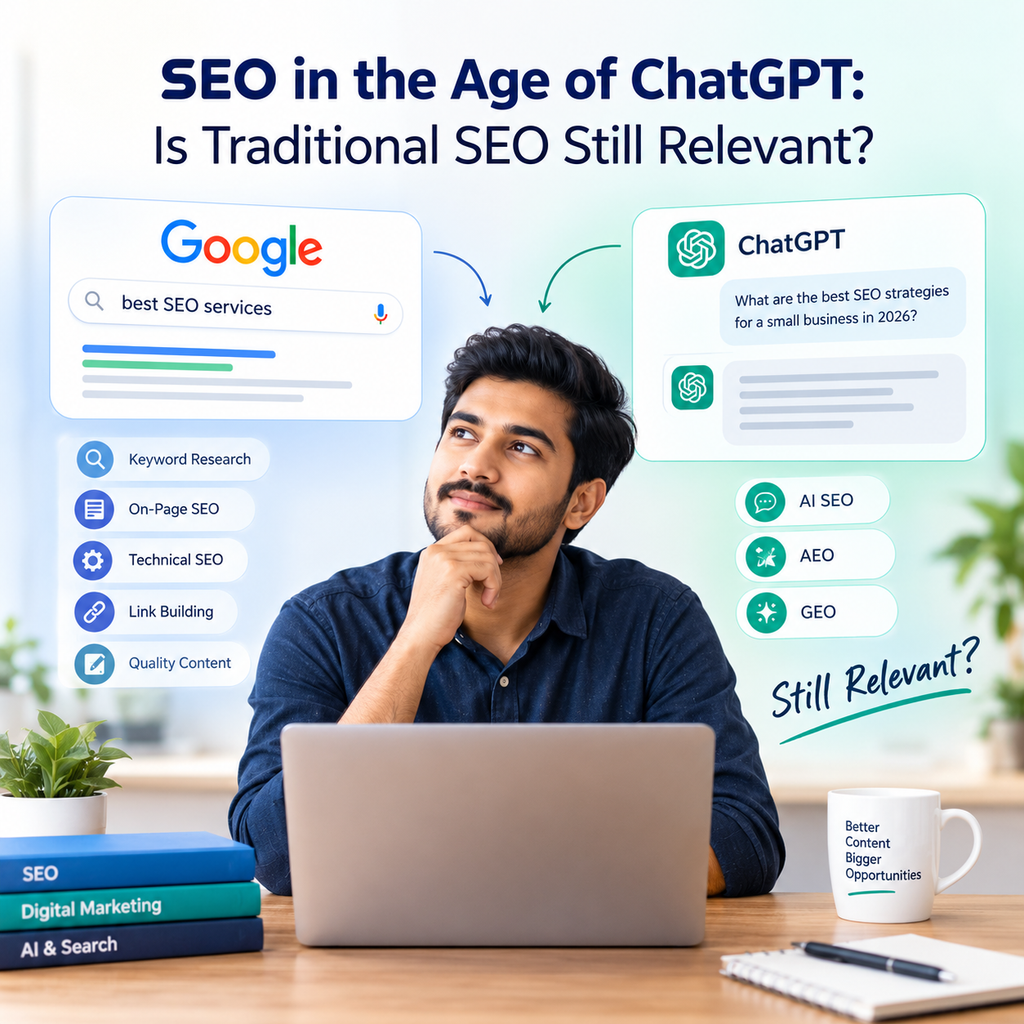
This change has made many website owners and digital marketers ask an important question: Is traditional SEO still relevant in the age of ChatGPT?
The short answer is yes. However, the way businesses approach SEO is evolving.
Search engines continue to help people discover websites, while AI-powered tools are changing how people search for information, compare options, and find answers. Businesses now need to think beyond rankings and focus on content quality, website experience, credibility, and visibility across different search experiences.
In this blog, let’s explore how traditional SEO works alongside AI search, what has changed, and how businesses can prepare for the future.
What Is Traditional SEO?
Search Engine Optimization (SEO) is the process of improving a website so that search engines can understand its content and help users discover relevant pages.
Traditional SEO includes several important activities:
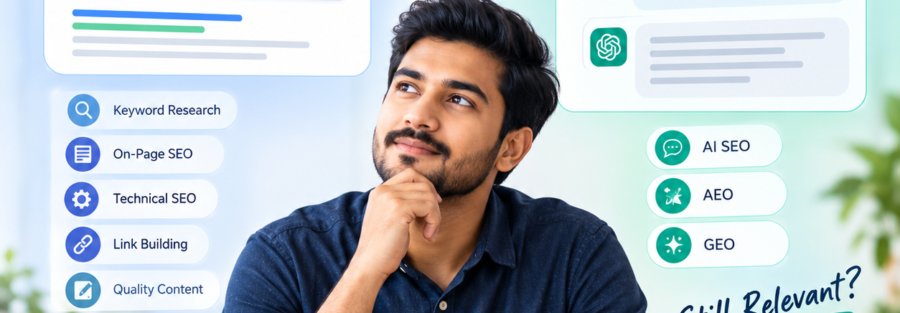
- Keyword research: Finding the words and phrases people use when searching online.
- On-page SEO: Improving page titles, headings, content, meta descriptions, and internal links.
- Technical SEO: Helping search engines crawl and understand a website.
- Off-page SEO: Building credibility through relevant links and other external signals.
- Content creation: Publishing useful, original information that answers users’ questions.
- Performance optimization: Improving website speed, mobile usability, and overall user experience.
For example, if a digital marketing agency wants to appear when people search for “SEO services in Tamil Nadu,” it may optimize relevant website pages around that topic.
These activities are not outdated simply because AI tools are becoming popular. Google states that its generative AI search features continue to rely on core search ranking and quality systems, meaning foundational SEO practices remain relevant.
How Is ChatGPT Changing the Way People Search?
ChatGPT has made it easier for people to ask questions in a conversational way. Instead of searching for separate keywords, users can describe what they need and ask follow-up questions.
For example:
Traditional Search:
Best SEO tools for small businesses
AI-Assisted Search:
I run a small business website. Which SEO tools should I use to find keywords, check website issues, and track performance?
The second question provides more context and explains the user’s needs.
AI tools can help users understand complex subjects, generate ideas, compare information, and explore solutions. At the same time, users may still visit websites to verify information, read detailed explanations, explore services, or make decisions.
This means businesses should not focus only on how a keyword ranks. They should also consider whether their content provides useful information that can be discovered and understood in different search environments.
The key change is not that search has disappeared. It is that the search experience is becoming more conversational and varied.
Is Traditional SEO Still Relevant in the Age of ChatGPT?
Yes. Traditional SEO remains an important part of a website’s visibility strategy.
Google’s official guidance explains that its generative AI search features are grounded in its search systems and that established SEO best practices continue to matter. Pages need to meet the relevant technical requirements and be eligible for Google Search to appear as supporting links in AI features.
However, this does not mean that following SEO best practices guarantees that a page will appear in every AI-generated answer. Search results and AI responses depend on the systems, queries, content, and context involved.
Here are some reasons traditional SEO continues to matter.
1. Search Engines Still Help People Discover Websites
Many people continue to use search engines to find businesses, services, products, and educational content.
A well-optimized website can make it easier for search engines to discover and understand its pages. Good keyword targeting, clear website structure, relevant content, and technical accessibility all support this process.
Even when users encounter AI-generated summaries, relevant website links can still be part of their journey toward more detailed information.
2. Technical SEO Supports Website Discoverability
AI search does not remove the need for a website that can be crawled, understood, and accessed.
Important technical SEO activities include:
- Checking whether important pages can be crawled.
- Improving website navigation and internal linking.
- Maintaining a clear URL structure.
- Ensuring important content is available in text.
- Improving mobile usability and page experience.
- Checking indexing issues using Google Search Console.
Google’s guidance for AI features continues to emphasize crawlability, indexability, internal links, page experience, and accessible content.
A technically weak website can create problems regardless of whether visitors arrive through traditional search or an AI-assisted search experience.
3. Helpful Content Builds Long-Term Value
People do not visit websites only to see keywords. They want useful answers, practical guidance, trustworthy information, and solutions to their problems.
Suppose you are writing a blog about digital marketing for beginners. Instead of repeating the keyword “digital marketing tips” throughout the article, you can explain:
- What digital marketing means.
- How SEO and social media marketing work.
- Which tools beginners can explore.
- Common mistakes to avoid.
- Examples of how businesses use digital marketing.
This type of content gives readers a reason to spend time on your website.
Google’s generative AI optimization guidance emphasizes unique, valuable, people-first content rather than content that simply repeats information already available elsewhere.
Traditional SEO vs AI Search Optimization
Traditional SEO and AI search optimization share several foundational principles, but their focus can differ.
| Traditional SEO | AI Search Optimization |
| Improving visibility in search engines | Improving the chances of being represented in AI search experiences |
| Keyword research and search intent | Conversational questions and user needs |
| On-page and technical SEO | Clear, useful, context-rich information |
| Search rankings and organic traffic | Visibility in AI-generated responses and supporting links |
| Backlinks and website credibility | Trustworthy content and relevant information across sources |
| Website content optimization | Content that can be understood and used in different search contexts |
This comparison describes areas of emphasis, not two completely separate systems. Google’s official guidance treats foundational SEO as relevant to its generative AI search features, while terms such as AEO and GEO are used to describe specific approaches to AI search visibility.
A practical approach is to build strong SEO foundations and create content that is genuinely helpful to people.
What Is AI SEO, AEO, and GEO?
As AI tools become part of the search journey, marketers have started using terms such as AI SEO, Answer Engine Optimization (AEO), and Generative Engine Optimization (GEO).
Although these terms are used in different ways, they generally relate to improving how information is discovered, understood, or surfaced in AI-driven search and answer experiences.
AI SEO
AI SEO commonly refers to adapting SEO workflows and content strategies to the growing role of artificial intelligence in search.
It may include:
- Understanding AI-assisted search behavior.
- Creating useful content for conversational questions.
- Monitoring visibility in relevant search experiences.
- Using AI tools to support research and content planning.
Answer Engine Optimization (AEO)
AEO is often used to describe efforts to make content useful for systems that provide direct answers to questions.
For example, a page answering “What is technical SEO?” can use a clear heading, a concise explanation, and additional detail for readers who want to learn more.
Generative Engine Optimization (GEO)
GEO is commonly used for strategies focused on visibility in generative AI search experiences.
However, there is no single universally accepted method that guarantees a website will be mentioned by ChatGPT or another AI system. Google’s own guidance cautions against unsupported AI-search hacks and states that special AI files or markup are not required for visibility in its generative search features.
Instead of chasing every new optimization term, businesses should focus on sound SEO principles, original content, and a clear understanding of their audience.
7 Ways to Adapt Your SEO Strategy for the AI Era
The goal is not to abandon traditional SEO. It is to strengthen your website strategy so that your content remains useful as search behavior changes.
1. Focus on Search Intent, Not Just Keywords
Keywords are still useful, but understanding the reason behind a search is equally important.
Consider the keyword:
“Best digital marketing course”
A person searching this phrase might want to know:
- Which topics the course covers.
- Whether the course is suitable for beginners.
- How long the course takes.
- Whether practical training is included.
- What career opportunities may be available.
A helpful blog or landing page should address the questions that matter to its audience.
Tip: Before writing content, ask yourself: “What does the reader actually want to know or accomplish?”
2. Create Original and Experience-Based Content
AI can produce information quickly, but generic content often lacks personal experience and practical insight.
Businesses can make their content more useful by including:
- Real project examples.
- Industry-specific observations.
- Original research or data, where available.
- Practical instructions.
- Expert explanations.
- Genuine customer questions and solutions.
For example, a digital marketer writing about SEO audits could explain how they identified a broken internal link, evaluated a sitemap, or improved a page’s structure. Such details can add value beyond a general definition of SEO.
Google encourages content that offers original value and experience rather than material that could easily be reproduced without meaningful insight.
3. Improve Your Website’s Technical Foundation
A beautiful blog design is helpful, but the website also needs a reliable technical foundation.
A basic technical SEO checklist includes:
Technical SEO Checklist
- [ ] Check important pages for indexing issues.
- [ ] Review your XML sitemap.
- [ ] Check robots.txt and crawling access.
- [ ] Improve internal linking.
- [ ] Check mobile responsiveness.
- [ ] Improve page loading experience.
- [ ] Review broken links and redirects.
- [ ] Use structured data when it is relevant and correctly implemented.
Technical SEO helps search engines access and interpret website content. Google also states that structured data is not a special requirement for generative AI search, although it can remain useful for eligibility for relevant rich results.
4. Write Content in a Clear and Natural Way
People prefer content that is easy to understand.
Instead of making every paragraph sound formal or stuffing it with keywords, use a natural writing style.
Example:
Less natural:
SEO optimization is an important SEO strategy that helps optimize websites for SEO optimization and better SEO rankings.
More natural:
SEO helps businesses improve their website’s visibility and make it easier for people to find relevant information through search engines.
The second example communicates the idea without unnecessary repetition.
Use descriptive headings, short paragraphs, relevant examples, and straightforward explanations. This makes the content easier for readers to navigate and understand.
5. Build Trust Through Relevant Information
When people discover a business through search or AI, they may want to know whether the business is reliable.
Your website can communicate trust by providing:
- Accurate business information.
- Clear service descriptions.
- Author information where relevant.
- Contact details.
- Genuine testimonials, where available.
- Relevant examples of work.
- Updated and transparent information.
Trust is not created through keywords alone. It develops through the quality of the information and the experience people have with your website and business.
6. Use AI Tools as Assistants, Not Replacements for Expertise
ChatGPT and other AI tools can help digital marketers with research, brainstorming, content outlines, and editing.
For example, you can use AI to:
- Generate initial blog topic ideas.
- Identify questions related to a subject.
- Create a draft outline.
- Suggest alternative explanations.
- Review content for clarity.
However, the final content should be checked, edited, and improved by a person who understands the topic.
AI-generated content can contain inaccurate claims, outdated information, or generic explanations. Google states that using generative AI is not inherently prohibited, but generating many pages without adding value can violate its spam policies.
The best workflow combines AI assistance with human review, original insight, and fact-checking.
7. Measure More Than Keyword Rankings
Keyword rankings remain useful, but they are only one part of evaluating SEO performance.
Businesses can also monitor:
- Organic search traffic.
- Search impressions and clicks.
- Click-through rate.
- Relevant conversions.
- Indexed pages.
- Engagement with important landing pages.
- Leads or enquiries from organic search.
Google Search Console provides information about a website’s performance in Google Search. Google’s 2026 guidance also describes a Generative AI performance report for measuring visibility in relevant generative AI features.
AI search visibility can be difficult to measure consistently across platforms. Therefore, businesses should avoid relying on one third-party score or assuming that a single metric represents their entire search performance.
Does Ranking on Google Guarantee Visibility in ChatGPT?
No. A strong Google ranking does not automatically guarantee that a website will be mentioned in ChatGPT.
Search systems and AI tools may use different methods to retrieve, interpret, and present information. Their responses can vary depending on the question, available information, system behavior, and other factors.
A website that ranks well in traditional search may still need to focus on clear content, reliable information, and a strong overall digital presence.
At the same time, appearing in an AI-generated answer is not a guaranteed result of following a particular SEO checklist. There is no universal formula that ensures a brand will be recommended by every AI tool.
The practical lesson is to avoid treating AI visibility as a replacement for SEO. Instead, businesses should develop content and website practices that support their wider digital marketing goals.
Common SEO Mistakes to Avoid in the Age of ChatGPT
As AI search grows, some businesses may be tempted to follow every new trend. A more careful approach can help avoid wasted effort.
Mistake 1: Assuming Traditional SEO Is Dead
Search behavior is changing, but SEO fundamentals remain relevant. Ignoring technical SEO, content quality, and website usability can create problems for organic search visibility.
Mistake 2: Publishing Large Amounts of Generic AI Content
Publishing many articles without adding useful information can lead to repetitive, low-value content. AI should support a thoughtful content process rather than replace research and editorial review.
Mistake 3: Focusing Only on Keywords
Keywords are useful for understanding search demand, but content should also answer the user’s question and provide meaningful information.
Mistake 4: Believing Every AI SEO Hack
Not every claim about AI search optimization is supported by official guidance. For example, Google says that special llms.txt files are not required for visibility in Google Search’s generative AI features.
Mistake 5: Forgetting the Human Reader
Content written only to satisfy algorithms may become difficult to read. Your audience should remain at the center of your content strategy.
The Future of SEO: A Combined Approach
The future of SEO is likely to involve a combination of established practices and new ways of understanding search behavior.
Businesses should continue investing in:
- Strong technical SEO.
- Helpful, original content.
- Relevant keyword and audience research.
- Website usability.
- Brand credibility.
- Performance measurement.
- Adaptation to new search experiences.
AI tools may change how users find information, but businesses still need to communicate what they offer and why their information is valuable.
For example, a local business website should clearly explain its services, service area, contact information, and relevant customer needs. These details can support people who discover the business through traditional search, AI-assisted search, social media, or direct visits.
Rather than asking whether SEO or AI search is the only path forward, businesses can ask a more practical question:
How can we create a website that is useful to people and ready for different ways of discovering information?
Conclusion: Traditional SEO Is Evolving, Not Disappearing
The rise of ChatGPT and AI-powered search is changing the digital marketing landscape. People are exploring new ways to find information, and businesses need to adapt to these changes.
However, traditional SEO is still relevant. Technical optimization, helpful content, keyword research, and a good website experience continue to provide important foundations for search visibility.
The most effective approach is to combine SEO fundamentals with an understanding of AI-assisted search and changing user behavior.
You do not need to chase every AI trend. Start by improving your website, publishing content that genuinely helps your audience, and measuring the results of your efforts.
The future of SEO is not simply about ranking higher. It is about being useful, discoverable, and trustworthy wherever people search for information.
Frequently Asked Questions (FAQs)
1. Is traditional SEO still relevant in 2026?
Yes. Traditional SEO remains relevant because technical SEO, content quality, and search engine accessibility continue to support website visibility. AI-powered search features also rely on established search systems and content discovery processes.
2. Will ChatGPT replace Google Search?
ChatGPT and Google Search provide different search experiences, and their capabilities continue to evolve. ChatGPT does not mean that traditional search engines are no longer useful. People may use both AI tools and search engines depending on their needs.
3. What is the difference between SEO and GEO?
SEO is the broader practice of improving a website’s visibility in search engines. GEO, or Generative Engine Optimization, is a term commonly used for approaches focused on visibility in generative AI search experiences. The two areas overlap, and foundational SEO remains relevant to Google’s AI search features.
4. Can AI-generated content rank on Google?
AI-generated content can appear in search when it meets Google’s relevant quality and spam policies. However, using AI to create large quantities of low-value content without adding value can violate Google’s scaled content abuse policies. Content should be reviewed for accuracy, originality, and usefulness.
5. How can businesses prepare for AI search?
Businesses can prepare by maintaining strong technical SEO, creating original and helpful content, keeping important website information accurate, understanding their audience’s questions, and monitoring search performance. There is no guaranteed method for securing visibility in every AI search platform.